
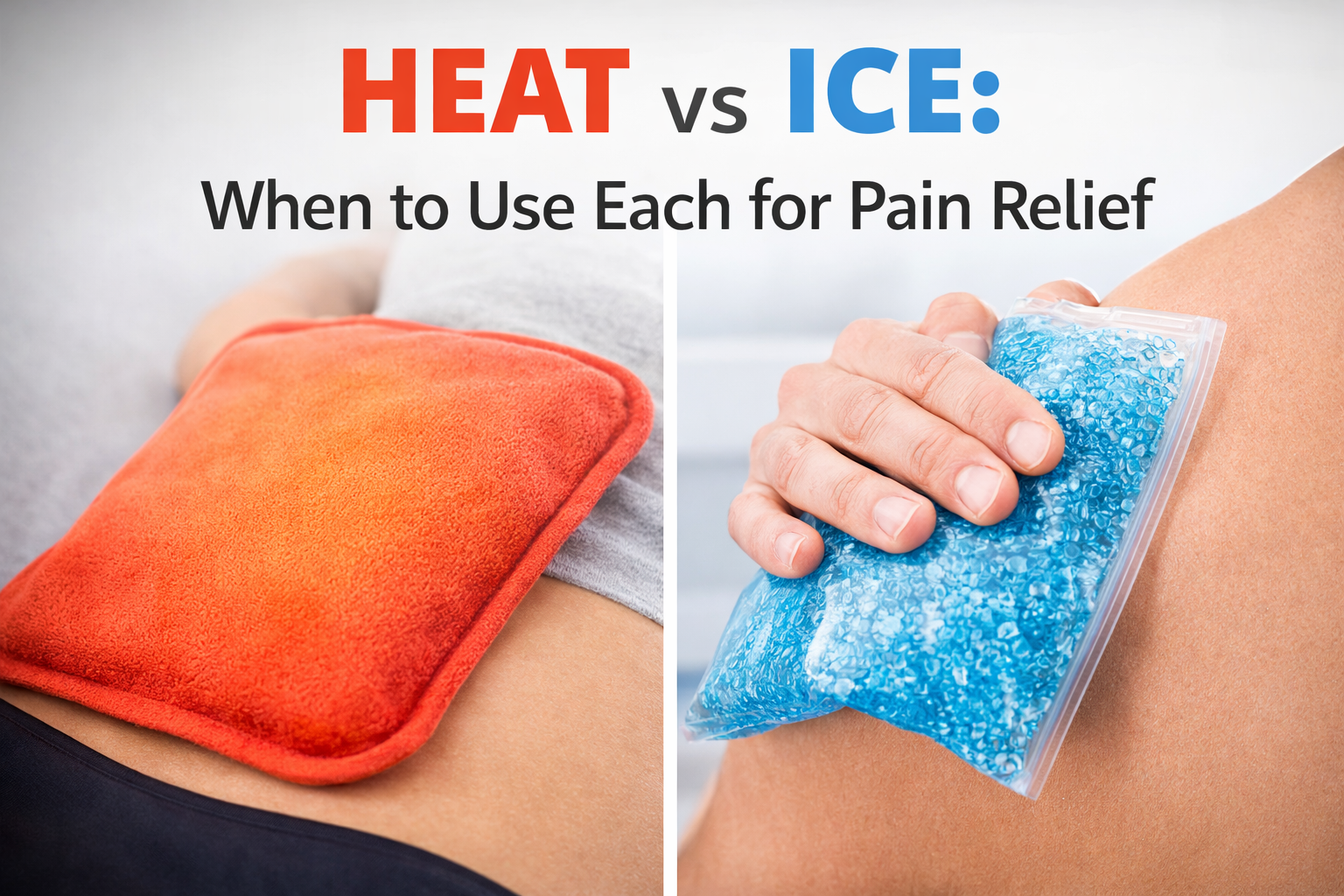
Heat vs Ice: When to Use Each for Pain Relief
One of the most common questions I hear in clinic is:
“Should I use heat or ice?”
If you’ve ever felt confused by the answer, you’re not alone. Over the years, recommendations have shifted and pain itself is complex.
However, when we combine the latest research with real-world clinical experience, some clear and practical patterns emerge.
Let’s break it down.
Why both Heat and Ice Can Reduce Pain
Both heat and ice can reduce pain in the moment, and they do so through a concept known as the Gate Control Theory of Pain.
Gate Control Theory of Pain (in plain language)
Think of your spinal cord as having a mechanism (a “gate”) that can control whether pain signals pass to the brain to get interpreted. Certain non-painful sensations (such as temperature—hot or cold—firm pressure, rubbing, and vibration) can close this gate, blocking or dampening pain signals. This is why you automatically grab and rub your toe when you stub it and why we use things like TENS machines or hot/cold therapy for pain management.
When Ice Is the Better Choice
Ice tends to work best for acute or recent injuries.
Aside from just reducing pain, ice may help limit early inflammatory responses, which can be useful shortly after an injury or during an acute pain flare.
In recent years new research has suggested that ice use after an injury may be better off limited to up to 48 hours after an injury, rather than the 72 hours recommended in the past. This is because prolonged use of ice may slow healing by excessively reducing blood flow to the area.
Ice is most helpful for:
- Acute/recent injuries
- Recent flare-ups
- Visible swelling
- Any soreness following treatments (chiropractic, massage, physio etc.)
- Inflammatory Arthritis
- Headaches and migraines
Clinical takeaway:
Ice can be useful early on after an injury when things feel achy, throbbing, sharp or burning. After about 48 hours you may want to switch to heat.
When Heat Is the Better Choice
Heat tends to work best for chronic pain patterns. That’s pain or discomfort that has been around for three or more months.
Aside from just reducing pain, heat increases blood flow, improves tissue elasticity, and helps muscles relax.
Heat is most helpful for:
- Chronic/longstanding pain
- Joint stiffness
- Muscle tightness
- Long-standing tension
- Pain that feels worse after inactivity
- Fibromyalgia
- Degenerative/Osteoarthritis
- Tendonitis/tendinosis*
*This one is a bit counterintuitive—and it’s another area where research has changed our understanding. Many conditions that were once labeled tendinitis are now more accurately described as tendinosis, which reflects a chronic degenerative process rather than an acute inflammatory one.
In conditions such as tennis elbow (lateral epicondylosis) and golfer’s elbow (medial epicondylosis), the tendon isn’t primarily inflamed— it’s undergoing gradual degenerative changes over time. Repetitive use causes the tissue to exceed its capacity and eventually tips into injury. So, the recommendation used to be to ice these conditions but better understanding of what’s going on has changed the recommendation to using heat.
Clinical takeaway:
Heat is often my go-to recommendation for chronic pain, stiffness, and tightness when inflammation is no longer the primary issue.
Why Heat Can Make Inflammation Worse Later
This is an important — and often misunderstood — point.
While heat may feel soothing to any injury initially, applying it to an actively inflamed area can increase blood flow to tissue that is already irritated. This may lead to increased inflammation and worse symptoms later.
Many patients tell me:
“Heat felt great at first, but I felt worse that evening or the next day.”
This response is common when heat is used on an acute inflammatory condition.
A simple rule of thumb:
- If an area is hot, swollen, or recently injured, heat may backfire later
- If pain is long-standing, stiff, or tight, heat is usually helpful
Directions for Use
Limit any single session to 15–20 minutes and always use a cloth barrier (like a towel) between the heat or ice source and your skin to prevent burns or tissue damage.
For ice to have a therapeutic effect it generally needs to be applied long enough for the area to get completely numb. That means you must get through the area feeling Cold–> Burning–> Aching–> Numb (CBAN).
Temperature can be a helpful short-term tool, but it doesn’t address the underlying cause of pain.
Final Thoughts
The heat vs ice debate isn’t about choosing a universal winner. It’s about matching the tool to the type of pain you’re experiencing.
By combining current research with consistent clinical patterns, we can make smarter, more individualized decisions — and avoid accidentally making symptoms worse.
If you’re unsure which option is right for you, or if pain continues to return, it may be time to look beyond temperature alone.
If pain or stiffness is affecting your daily life, we’re happy to help you determine the best next steps.